By XAMXAM
What began as a routine budget hearing on Capitol Hill slowly transformed into a revealing moment of institutional unease. Again and again, lawmakers asked the same straightforward question: if the Federal Bureau of Investigation is facing a cut of more than half a billion dollars, who exactly will lose their jobs? And again and again, the answer never came.

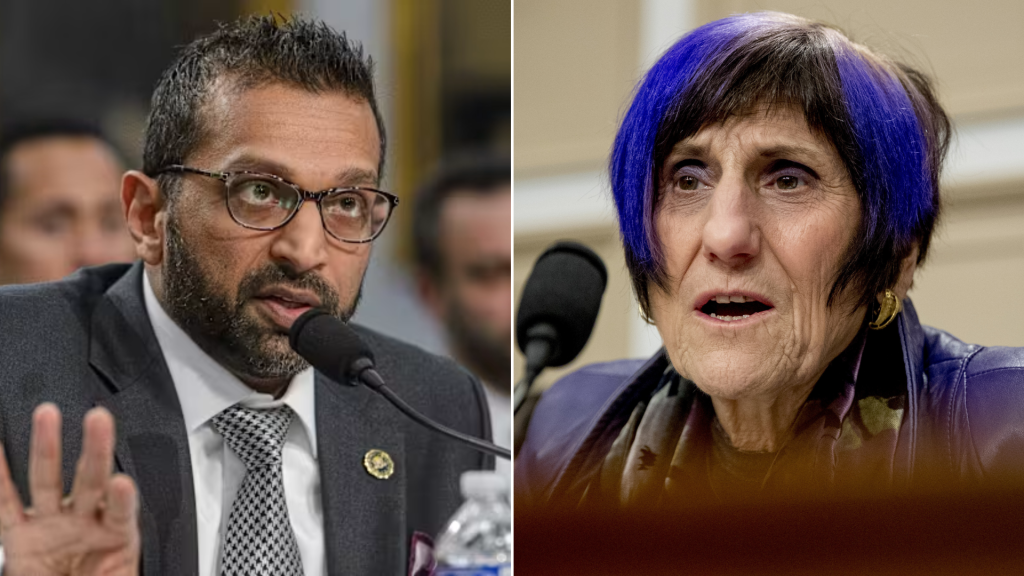
At the center of the exchange was Rosa DeLauro, a senior appropriator known less for theatrics than persistence. Sitting across from her was Kash Patel, who had arrived before Congress with a contradictory message. On the one hand, Patel argued that the FBI urgently needed more funding to confront violent crime and national security threats. On the other, he defended a budget framework that would reduce the bureau’s funding by more than five percent—pushing it below current operating levels and closer to what the agency functioned on more than a decade ago.
DeLauro’s questions were not ideological. They were procedural and practical. Congress controls the purse strings, and lawmakers are required to understand the consequences of the budgets they approve. A cut of this magnitude, she argued, could not be absorbed without real losses—intelligence analysts, investigative capacity, or programs designed to prevent violence before it occurs. The only thing she wanted to know was which ones.
Patel’s responses were striking for their vagueness. He explained that the FBI had not yet determined which positions would be cut, emphasizing instead that he was working with appropriators to avoid those reductions altogether. The budget, he suggested, was not truly “his,” but a proposal emerging from a broader administration process. If funding were restored to roughly $11.2 billion, he insisted, no positions would need to be eliminated.
That explanation only sharpened the concern. If the cuts were real enough to be proposed, lawmakers asked, how could the agency not know where they would land? Large organizations do not absorb hundreds of millions of dollars in reductions by accident. They plan for them. They model scenarios. They identify trade-offs. The absence of that clarity raised a more troubling possibility: that the consequences of the cuts were either not fully understood or not being openly discussed.
Patel repeatedly returned to a single justification—moving personnel from Washington to field offices to better address violent crime nationwide. On its surface, the argument sounded sensible. Communities want visible law enforcement, and the FBI has long faced criticism for being too centralized. But intelligence professionals note that analysts are not interchangeable with field agents. Intelligence work relies on continuity, specialization, and institutional memory. Reducing or destabilizing that workforce does not simply shift priorities; it alters what the agency can know and anticipate.
The hearing underscored a larger tension within federal law enforcement budgeting. Political leaders often promise to be tough on crime while simultaneously supporting cuts that weaken the infrastructure behind that promise. Intelligence analysis, cybersecurity monitoring, counterterrorism assessments—these functions rarely produce dramatic headlines, but they are often the first to suffer when budgets tighten. Their value becomes visible only when something goes wrong.
DeLauro’s insistence on specifics reflected an older norm of congressional oversight, one that treats budgeting as a matter of accountability rather than messaging. She was not asking Patel to predict the future, only to explain the logic guiding his decisions. What criteria would determine which programs survived? What evaluation process justified shifting positions or freezing initiatives? Without those answers, lawmakers are left to vote blind.
The exchange also highlighted a subtle erosion of responsibility. Patel drew a line between the FBI’s internal request and the administration’s “skinny budget,” implying that the most severe cuts were imposed from above. But leadership, critics argue, means owning the outcome even when the decision originates elsewhere. An agency director cannot credibly warn of dire threats while distancing himself from the budget that shapes the agency’s ability to meet them.
By the end of the hearing, the unanswered questions had become the point. Oversight is not about scoring political victories; it is about forcing clarity where power and money intersect. When the head of a federal agency cannot—or will not—explain how massive reductions would affect its core mission, that ambiguity itself becomes a matter of public concern.
Budget debates often feel abstract, buried in spreadsheets and acronyms. But behind every line item are people, capabilities, and choices about what risks a society is willing to take. In this case, the silence surrounding those choices spoke volumes. It suggested not just a disagreement over numbers, but an uncertainty about priorities—and about who bears responsibility when promises collide with reality.