Minnesota Pushes Forward Independent Probe as DOJ Declines to Investigate Killing of Protester Renee Good
The killing of Renee Good, who was shot and killed during a protest against a federal Immigration and Customs Enforcement (ICE) operation in Minneapolis, has ignited a widening confrontation between Minnesota state officials and the U.S. Department of Justice, raising sharp questions about accountability, federal overreach, and the rule of law.
Good was participating in what witnesses and state officials describe as a peaceful protest against an ICE enforcement surge when she was shot multiple times in the head. The shooter has been identified by state officials as Jonathan Ross, an ICE agent. To date, federal authorities have said they will not pursue a criminal investigation into Ross’s actions.
That decision has prompted fierce criticism from Minnesota officials, including Attorney General Keith Ellison, who confirmed that the state is conducting its own parallel investigation despite limited cooperation from federal agencies.
Federal Investigations—But Not of the Shooter
According to Ellison, the Department of Justice and FBI have opened or threatened investigations into a wide array of individuals connected to the aftermath of the shooting—including Minnesota Governor Tim Walz, Minneapolis Mayor Jacob Frey, protest organizers, and even Becca Good, Renee Good’s widow—while declining to investigate the ICE agent who fired the fatal shots.
“How can the federal government declare that it is not investigating the death of Renee Good while simultaneously denying the state access to the information it needs to complete its own investigation?” Ellison asked. “There is a word for that. It’s called a cover-up.”
Federal officials have not publicly responded to that characterization.
Two Federal Court Cases, One Judge
The legal fallout from the shooting is unfolding before U.S. District Judge Kate Mendez, who is overseeing two separate but related federal cases.
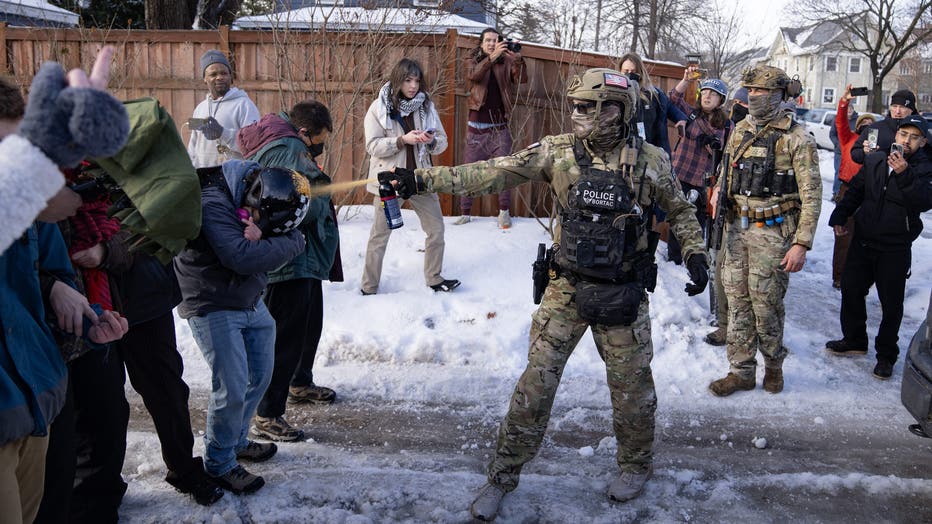
The first involves six protesters and a broader class of demonstrators, who allege that ICE agents violated their First and Fourth Amendment rights by using pepper balls, chemical agents, and physical force against individuals engaged in lawful protest and observation. In that case, Judge Mendez recently issued a preliminary injunction restricting ICE’s use of crowd-control weapons and unconstitutional stops.
The second case, brought by the Minnesota Attorney General’s Office, challenges the legality of ICE’s broader enforcement tactics in the state. Briefing in that matter is ongoing, with additional filings due in the coming days.
Homeland Security Pushes Back
Homeland Security Secretary Kristi Noem publicly dismissed Judge Mendez’s injunction, calling it “a little ridiculous” and asserting that it merely instructs ICE agents not to do what they were “already not doing.”
Ellison sharply disagreed.
“The court’s order is essentially saying: obey the Constitution,” he said. “The problem is, they are not doing that, and the evidence is everywhere.”
Ellison cited reports of ICE agents stopping citizens, demanding identification based on accents, engaging in racial profiling, and using force against nonviolent demonstrators. He warned that the federal operation has caused widespread economic disruption, declining school attendance, and increased costs for state and local governments forced to respond with emergency aid programs.
State Investigation Moves Forward
Despite what Ellison described as federal obstruction, Minnesota has launched an independent investigation into Good’s killing. The Attorney General’s Office and the Hennepin County Attorney’s Office have entered into a memorandum of understanding, with the county serving as lead prosecutor and the state providing support.
The Minnesota Bureau of Criminal Apprehension (BCA) is collecting and cataloging evidence, including video footage, eyewitness accounts, and public submissions through a newly opened portal.
“We are doing the investigation we can do with the information available to us,” Ellison said. “No one should doubt our willingness to pursue justice. We have done so before, including in cases involving law enforcement officers who exceeded their legal authority.”
Ellison emphasized that the investigation remains ongoing and that no charging decision has yet been made.
A Case with National Implications
The death of Renee Good now sits at the intersection of immigration enforcement, protest rights, and federal–state tensions over accountability. For Minnesota officials, the case is not only about one shooting, but about whether federal agents can operate within states while remaining insulated from scrutiny.
As Ellison put it, “If the federal government can both refuse to investigate and block the state from investigating, then accountability disappears entirely.”
For Good’s family and supporters, the question remains painfully simple: whether the justice system will ever fully examine what happened on a Minneapolis street—and who, if anyone, will be held responsible.