🚨 BREAKING BETRAYAL: CANADA’S CHINA PIVOT BLOWS UP U.S. TRADE — TRUMP SUDDENLY STRIPPED OF LEVERAGE AS GEOPOLITICAL DRAMA IGNITES, ALLIES IN PANIC AND SECRET DEALS UNRAVELING 😱
Ottawa — For decades, Canada’s economic strategy rested on a single, powerful assumption: that access to the United States market was stable, dependable and effectively guaranteed. That premise shaped everything from energy infrastructure to agricultural exports, and it rarely faced serious challenge. But in recent months, Canadian policymakers have begun to act as though that assumption can no longer be taken for granted.
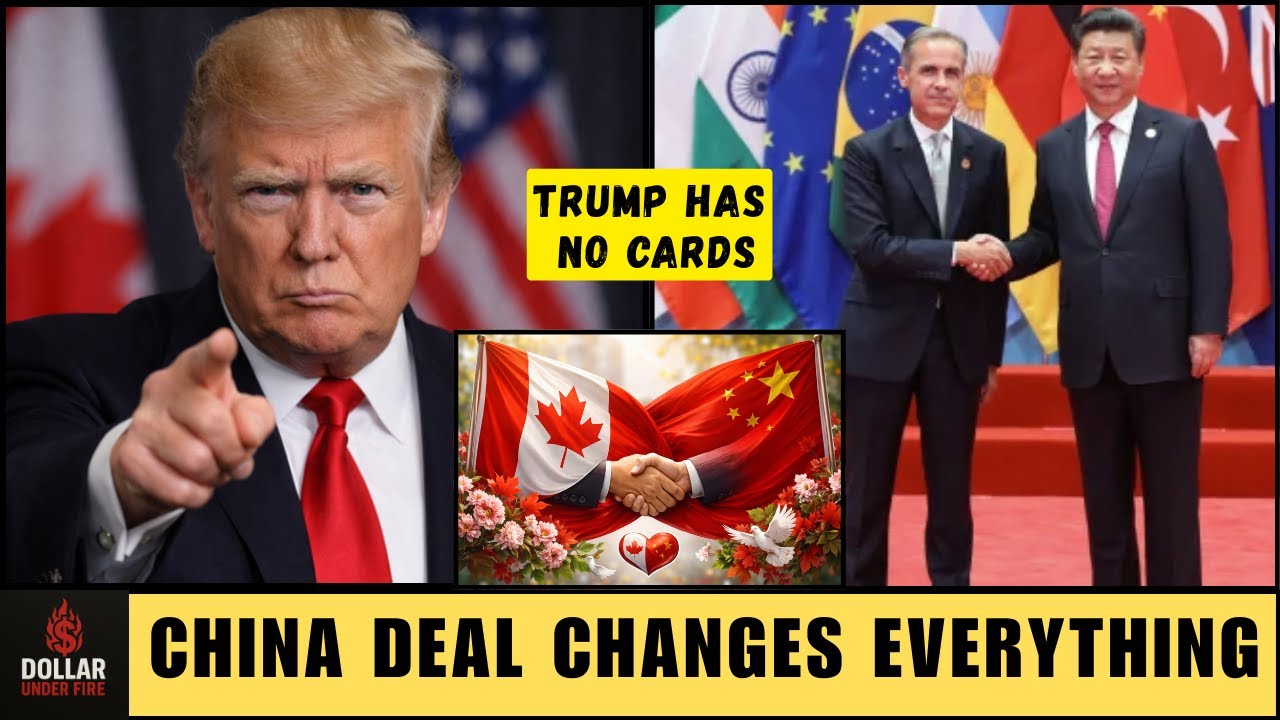
The shift has been subtle rather than confrontational. There have been no retaliatory tariffs, no public ultimatums and little rhetorical escalation. Instead, Canada has moved quietly to broaden its trade relationships, particularly in Asia, in what analysts describe as an effort to reduce vulnerability to political pressure from its closest ally.
That effort was underscored by a high-level Canadian visit to Beijing this year, the first such trip in nearly a decade. When Mark Carney arrived in China, officials described the visit not as a reset but as “re-engagement,” a deliberately modest term that nonetheless signaled a thaw after years of strained relations.
Canada’s relationship with China had effectively frozen following diplomatic disputes and trade retaliation that disrupted key export sectors, including canola, pork and seafood. Ministerial channels stalled, trust eroded and commercial ties withered, not because demand disappeared, but because politics intervened. For years, Ottawa accepted those losses while remaining heavily reliant on the United States, which absorbs roughly three-quarters of Canadian exports.
That reliance once felt like strength. Increasingly, it is being treated as exposure.
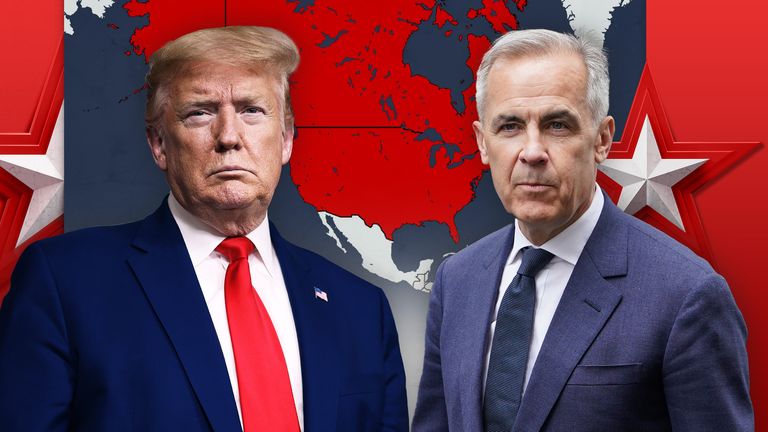
Under Donald Trump, trade policy has often been framed as leverage rather than partnership, with tariffs and economic threats deployed unpredictably, sometimes against allies. Canadian officials, while careful to avoid public confrontation, have privately acknowledged that such volatility has altered their risk calculations. When access to a dominant market can be questioned or conditioned at short notice, diversification becomes less an aspiration than a necessity.
The Beijing discussions reflected that logic. According to people familiar with the talks, negotiations focused on pragmatic, transactional issues rather than ideological alignment. Among the topics were agricultural market access and the potential easing of Chinese trade restrictions that have weighed heavily on Canadian producers. For farmers and exporters, the prospect of restored access to a large market offered immediate relief rather than abstract strategic benefit.
Energy has also played a central role in Canada’s recalibration. The recent expansion of West Coast pipeline capacity has enabled Canadian oil to reach Asian markets directly, without transiting U.S. infrastructure. Once such supply chains are established, analysts note, they tend to persist. Refineries adapt to specific crude blends, contracts extend over years, and commercial relationships harden into structural ties.
This does not amount to a rejection of the United States, Canadian officials insist. The U.S. remains Canada’s largest trading partner by a wide margin, and economic integration across the border is deep. But the objective now is insulation rather than substitution — creating credible alternatives so that no single partner can exercise disproportionate influence.
Similar strategies have been pursued elsewhere. Australia, after experiencing Chinese trade retaliation earlier this decade, invested heavily in diversification, expanding markets and infrastructure until leverage diminished and restrictions were quietly relaxed. Canadian policymakers have studied that experience closely.
There are risks in renewed engagement with China. Beijing has a record of using economic pressure to advance political objectives, and Canadian officials are wary of replacing one dependency with another. For that reason, diversification efforts extend beyond China to include Europe, Southeast Asia and India, alongside renewed interest in liquefied natural gas projects aimed at Asian buyers.
The implications for Washington are complex. The United States depends heavily on Canadian energy, minerals and agricultural inputs, which are deeply embedded in American supply chains. Severe disruption would raise costs for U.S. consumers and manufacturers alike. That interdependence constrains how far pressure tactics can realistically go — a reality that becomes more salient as Canada’s alternatives multiply.
Trade leverage is most effective when options are scarce. As Canada builds them, the balance shifts. Tariff threats lose urgency, negotiations become less asymmetrical, and diplomacy regains space.
Whether this strategy succeeds will depend on execution: sustained infrastructure investment, real trade flows and careful management of competing relationships. But one conclusion is already evident. Canada is no longer organizing its economic future around the assumption of automatic access to a single market.
In a world where trade has become increasingly politicized, Ottawa appears determined to ensure that dependence does not become destiny.