By XAMXAM
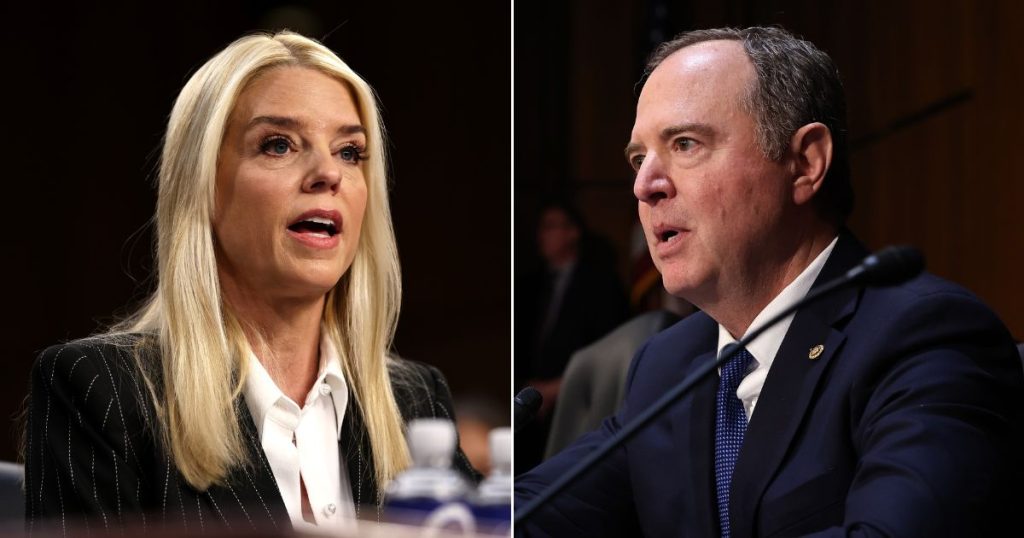
The most unsettling moments in congressional hearings are not always defined by what is revealed, but by what remains conspicuously unanswered. That dynamic was on full display this week when Representative Adam Schiff confronted Attorney General Pam Bondi with a direct and narrowly framed question: did a senior administration official take $50,000 in cash, and why was the investigation into that allegation quietly shut down?
Bondi did not answer. Not once. And in a hearing ostensibly devoted to oversight of the Department of Justice, that silence became the central fact.

The allegation itself is stark. According to multiple media reports cited during the hearing, Tom Homan, now a top deportation official working closely with the White House, was allegedly caught on tape in 2024 accepting a bag containing $50,000 in cash from undercover FBI agents. The reports claim the money was tied to promises of facilitating future government contracts once a new administration took office. The investigation, Schiff noted, was later closed without public explanation.
Schiff did not accuse Homan of guilt. Instead, he pursued a more fundamental line of inquiry: whether the Justice Department had fulfilled its obligation to investigate potential corruption without fear or favor. He asked whether the cash changed hands. He asked whether any audio or video evidence existed. He asked whether Bondi would support providing such evidence to Congress if it did. Each time, the response was deflection.
Bondi repeatedly emphasized that the investigation predated her confirmation. She deferred responsibility to other officials, cited assurances from subordinates, and praised the credibility of the White House press secretary. At no point did she address the factual core of the allegation. When pressed on whether she would support sharing evidence with Congress, she declined again, framing the questions as political attacks rather than legitimate oversight.
What made the exchange resonate was not its confrontational tone, but its implications. Oversight hearings are not criminal trials. Members of Congress are not prosecutors, and attorneys general are not witnesses under indictment. The purpose of such hearings is narrower and more structural: to determine whether the machinery of justice is operating according to consistent standards. When an investigation into a powerful official is closed, Congress has the right—and the responsibility—to ask why.
Schiff argued that this case is not an isolated incident but part of a broader pattern. He cited the dismissal or resignation of hundreds of career prosecutors, warnings from more than a thousand former Justice Department officials, and repeated instances in which investigations involving allies appeared to evaporate while prosecutions of perceived enemies were accelerated. The concern, he said, is not partisan imbalance but institutional decay.
Historically, the Justice Department has guarded its independence jealously, precisely because public trust depends on the perception that justice is blind to political status. Attorneys general from both parties have understood that even the appearance of selective enforcement can be corrosive. That is why explanations matter. A decision not to prosecute can be justified by evidence, law, or jurisdiction. A refusal to explain that decision invites suspicion.
The hearing also illuminated the internal cost of such opacity. Schiff referenced letters from former prosecutors who described being pressured to take actions they believed were unethical or legally unsound. These are not ideological actors but career professionals whose legitimacy derives from continuity across administrations. When they warn that lines are being crossed, the warning carries weight.
Bondi’s strategy—responding to questions with counterattacks and appeals to loyalty—may be politically effective in the short term. But institutionally, it raises a more troubling question: what happens when accountability itself is treated as optional? If oversight questions can be dismissed as slander, and if silence becomes an acceptable response to serious allegations, the balance between power and restraint begins to tilt.
The most telling moment came near the end of Schiff’s remarks, when he listed the questions Bondi had refused to answer—not just about the $50,000 allegation, but about ethics consultations, document flagging in the Epstein investigation, and the firing of career officials. The accumulation was deliberate. Each unanswered question, taken alone, might be explained away. Taken together, they form a pattern of evasion that no amount of rhetoric can fully obscure.
In democratic systems, accountability rarely collapses in a single dramatic act. It erodes incrementally, through unanswered questions, deferred responsibility, and the normalization of silence. What happened in that hearing matters not because guilt was established, but because clarity was denied. And in matters of justice, denial of clarity is never neutral.
The question left hanging is simple and enduring: does the rule of law still operate the same way for those closest to power? Until that question is answered plainly, the silence heard in that hearing will continue to echo far beyond the room where it occurred.