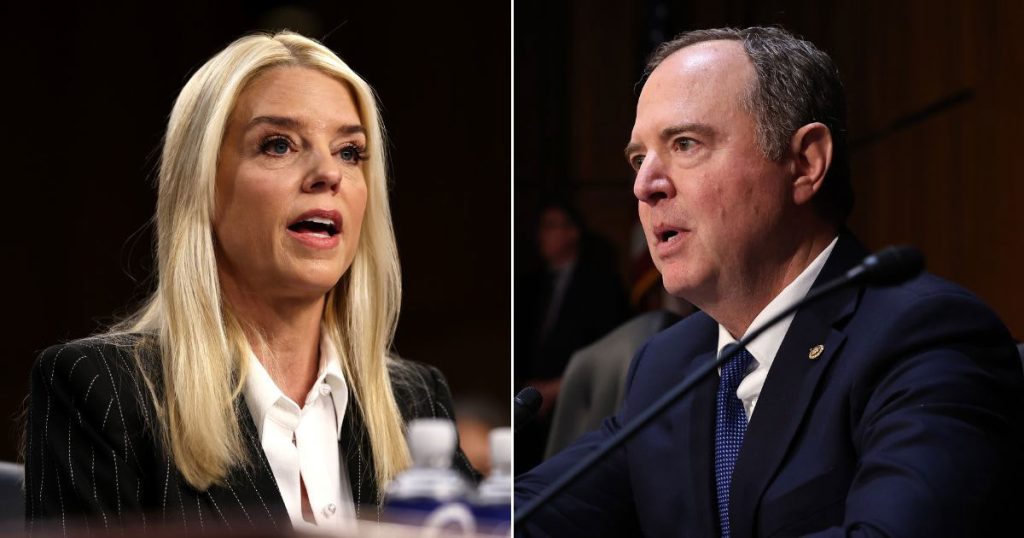
What unfolded during a recent Senate oversight hearing was not a shouting match or a viral exchange, but something more consequential: a sustained test of whether the Justice Department is still willing to answer basic questions from Congress.
Senator Adam Schiff, a California Democrat and former House impeachment manager, used his allotted time to do something increasingly rare in Washington. He read the record. One by one, he listed questions Attorney General Pam Bondi had declined to answer—questions involving ethics, prosecutorial independence, alleged corruption, and the legal justification for military actions authorized by the administration.

The exchange came amid heightened concern about the direction of the Justice Department under President Trump, following a series of firings of career prosecutors, stalled investigations, and controversial executive decisions. Schiff’s approach was deliberate. Rather than pressing Bondi with hypotheticals or political accusations, he asked whether she would support the release of evidence, acknowledge consultations with ethics lawyers, or clarify the legal basis for actions taken by her department.
In most cases, Bondi declined to respond directly.
At the center of Schiff’s questioning were several unresolved issues. One involved allegations that a senior administration official had received $50,000 in bribe money—an investigation Schiff said appeared to have quietly disappeared. Another concerned whether Bondi had consulted career ethics officials before approving President Trump’s acceptance of a $400 million gift from Qatar, a matter with constitutional implications under the Foreign Emoluments Clause.
Schiff also pressed Bondi on whether Trump’s name had been flagged in documents related to the Epstein investigation and whether any effort had been made to shield politically sensitive information from public or congressional scrutiny. Bondi refused to address the matter, citing either lack of authority or the need to defer to other agencies.
Perhaps most striking was Schiff’s line of questioning regarding military operations authorized by Defense Secretary Pete Hegseth. Schiff asked whether the Justice Department had evaluated the legality of strikes on boats in the Caribbean, actions that some legal experts have questioned under international law. Bondi again declined to explain the department’s position.
Rather than escalating rhetorically, Schiff pivoted. He read aloud a list of every question Bondi had not answered, framing the moment not as partisan conflict but as institutional failure. Oversight hearings, he reminded the committee, are designed to obtain information, not deflection.
The exchange highlighted a deeper tension now shaping Washington. Oversight depends on voluntary cooperation. Congress lacks the immediate enforcement power to compel answers in real time, relying instead on norms, precedent, and public accountability. When executive officials refuse to engage, the process slows, and transparency erodes.
Bondi’s defenders argue that many of the questions raised involved sensitive investigations or executive deliberations that should not be discussed in open session. They also point out that attorneys general from both parties have historically resisted congressional inquiries they view as encroaching on prosecutorial independence.
Critics counter that Schiff’s questions did not seek confidential strategy but basic clarification: whether ethics advice was sought, whether investigations were halted for political reasons, and whether the law was applied evenly. To them, refusal itself became the answer.
The hearing also unfolded against the backdrop of mass departures from the Justice Department. Schiff entered into the record letters from hundreds of former DOJ officials warning that recent actions—including calls to indict political opponents and the removal of career prosecutors—risk undermining the department’s credibility and effectiveness. One letter from a former counterterrorism prosecutor warned that politicization weakens the government’s ability to confront genuine national security threats.
What made the moment notable was its restraint. Schiff did not accuse Bondi of crimes. He did not raise his voice. Instead, he documented silence. In doing so, he shifted the focus from individual personalities to the health of the system itself.
The broader question raised by the hearing is whether democratic accountability can function when executive officials treat congressional oversight as optional. The Constitution grants Congress the power to investigate precisely to prevent the concentration of unchecked authority. When that power is neutralized by noncooperation, the balance envisioned by the framers weakens.
The hearing ended without resolution. No documents were produced. No explanations were given. But the record remains.
For supporters of the administration, the exchange may look like partisan theater. For critics, it was something more troubling: evidence that transparency is no longer assumed, but resisted.