By XAMXAM
When John Roberts, the Chief Justice of the Supreme Court of the United States, released his annual year-end report, the document arrived without drama. There were no headlines announcing a rebuke, no direct references to the president, no explicit acknowledgment of the political turbulence that has surrounded the judiciary in recent years. And yet, to many legal observers, the report read less like a routine administrative reflection and more like a carefully coded message—one aimed squarely at Donald Trump, without ever speaking his name.
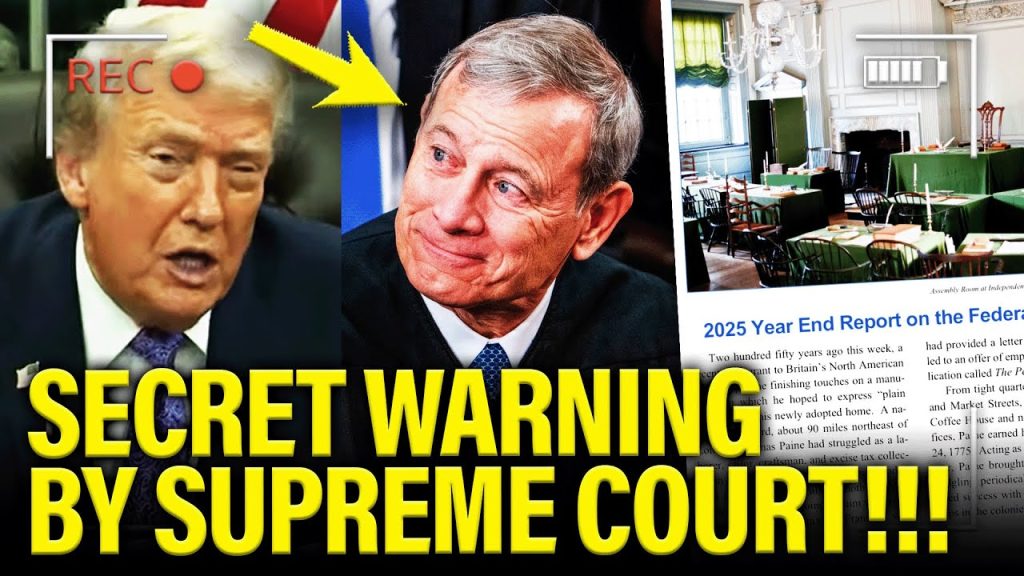
Roberts devoted the bulk of his report to history. He traced the intellectual lineage of American democracy back to the Enlightenment, to Thomas Paine, and to the ideals that animated the founding generation. He emphasized the enduring relationship between the Declaration of Independence and the Constitution, describing them as twin pillars that have held through war, upheaval, and partisan conflict. On its face, the essay was reflective and almost literary, an unusual tone for a document that in past years focused on budgets, caseloads, and courthouse security.
What was striking, however, was what Roberts chose not to say. There was no explicit mention of executive defiance of court orders, no reference to public attacks on judges, and no acknowledgment of the growing perception that the judiciary itself has become entangled in partisan struggle. For critics, that silence was deafening. For others, it was precisely the point.
In recent years, the Supreme Court has faced sustained criticism for decisions that expanded presidential immunity and relied heavily on emergency rulings issued through its so-called shadow docket. Those rulings, often unsigned and thinly explained, have allowed sweeping executive actions to take effect with minimal public justification. Roberts himself has warned in previous reports about the dangers of a judiciary that loses legitimacy in the eyes of the public. This year’s report, by contrast, seemed to retreat from direct warning and instead lean into reassurance.
By invoking the grievances against King George III—particularly the complaint that judges were made “dependent on his will alone”—Roberts appeared to gesture toward the importance of judicial independence without naming contemporary threats. The implication was subtle but difficult to miss: the legitimacy of American government depends on courts that are neither subservient to political power nor dismissed as partisan tools. In an era when loyalty tests and personal fealty have become recurring themes in political discourse, the historical analogy carried weight.
Still, the restraint frustrated many legal scholars. They argue that the moment demands clarity, not parables. The courts are increasingly asked to referee conflicts that strike at the heart of democratic governance, from election administration to the limits of executive authority. Against that backdrop, Roberts’s decision to cloak his message in symbolism felt to some like an abdication of moral leadership.
Others read the report more generously. They noted that year-end reports have traditionally avoided overt political confrontation, and that Roberts may be attempting to preserve the Court’s institutional standing by speaking in a register above daily conflict. By grounding his message in foundational texts and shared history, he may be signaling that the Court understands what is at stake—even if it is unwilling, or unable, to say so plainly.
The tension reflects a deeper dilemma facing the judiciary. Speak too directly, and the Court risks appearing partisan, reinforcing claims that it is just another political actor. Speak too obliquely, and it risks irrelevance, or worse, complicity through silence. Roberts’s report walks that narrow line, offering reassurance to those who want to believe the guardrails still hold, while providing little comfort to those who fear they are already eroding.
The timing only sharpened the ambiguity. The country is approaching the 250th anniversary of its founding amid profound questions about the durability of its institutions. Executive power has expanded aggressively, public trust in the courts has declined, and compliance with judicial rulings is no longer taken for granted. Against that backdrop, Roberts’s insistence that the nation’s “great charters of freedom and justice remain firm and unshaken” sounded, to some ears, more aspirational than descriptive.
Whether the report will matter in practice is an open question. Annual reports rarely change behavior or policy. Their significance lies instead in what they reveal about how the Court sees itself. This one suggests a Chief Justice acutely aware of history, deeply invested in the Court’s image as a stabilizing force, and reluctant to confront political power head-on.
In the end, the most revealing aspect of Roberts’s message may not be its lofty language, but its careful omissions. In a moment when many Americans are looking to the judiciary for unmistakable signals of resolve, the Chief Justice offered something quieter: a reminder of ideals, a nod to precedent, and an implicit hope that the system will correct itself.
Whether that hope is sufficient—or whether silence will be remembered as caution or evasion—will be judged not by history books alone, but by the cases yet to come and the choices the Court makes when those ideals are tested in real time.