The Philadelphia Eagles find themselves facing an unusual and increasingly uncomfortable storyline as they push through December: one of their most productive defenders, rookie Jihaad Campbell, has been benched not for struggling but because the team simply cannot find space for him in a suddenly crowded linebacking unit. It’s a reality that would sound absurd if the numbers didn’t support just how good Campbell has been. Through his first eleven games, he graded as a top-10 linebacker in the NFL, earned top-five marks in coverage, and looked every bit like the long-term centerpiece the Eagles hoped he might become. Yet as the season reaches its most crucial stretch, he has quietly been pushed to the sideline.

Before Nakobe Dean returned from a lengthy knee rehab, Campbell was a fixture on the field. He played an average of 63 snaps a game and rarely came off, logging over 90 percent of the defensive workload and serving as one of the unit’s most reliable tacklers. The rhythm and confidence he developed were evident: he diagnosed plays quickly, moved fluidly in space, and delivered the kind of consistency that is rare for rookie linebackers in Vic Fangio’s system. But once Dean reclaimed his role as the defensive signal-caller, the staff began reorganizing personnel, and Campbell’s usage cratered almost overnight. Twenty snaps against Detroit. Eleven against Dallas. And against Chicago? Not a single defensive snap.
For Campbell, it marked a statistical oddity. He became the first healthy Eagles first-round defensive pick to record zero defensive snaps in a game since Marcus Smith in 2014 — a distinction that hardly reflects his level of play. Fangio has been clear that Campbell’s benching isn’t performance-related. Rather, the decision reflects the coaching staff’s commitment to Dean as the middle linebacker and Zack Baun as the preferred complement. At a certain point, the numbers game squeezes someone out, and Campbell, despite playing at a near-elite level early in the season, became that someone. The situation raises one of the more complicated questions facing the Eagles down the stretch: how do you limit a player whose trajectory is pointing straight upward?
What has stunned many observers is not the benching itself but Campbell’s response to it. Instead of showing irritation or retreating emotionally, the 22-year-old delivered a remarkably calm, team-first message that instantly resonated across the locker room and wider NFL conversation. “This is not no basketball team, where I’m looking to score 40 points, and then if I don’t score the next 40 points, I’m going to be pissed off,” he said. “It’s all about wanting joy for yourself, of course, and wanting joy for everybody else that’s around you. I love watching our guys play. I love watching myself play on tape.” For a rookie who already logged 53 tackles, an interception, two pass breakups, and strong coverage tape, those remarks reflected not only maturity but perspective.

Fangio did attempt earlier in the season to give Campbell edge snaps in an effort to keep him involved, but those opportunities disappeared once Jaelan Phillips, Brandon Graham, and Nolan Smith stabilized the rotation. Rather than viewing the shrinking role as a setback, Campbell pivoted toward embracing special teams — an area he hadn’t consistently played since his college days. During Dean’s absence, he logged just four snaps on special teams; in the four most recent games, that number jumped to eighteen. It isn’t glamorous work, but it reflects a broader truth about Campbell: he is determined to contribute anywhere the team needs him, and his enthusiasm has earned praise from coaches who value his willingness to adapt.
That adaptability might matter sooner than expected. The Eagles were forced to play 85 defensive snaps in their loss to the Bears, the most in a non-overtime game since 2016. Fatigue set in, and Fangio admitted afterward that it was a mistake not to rotate Campbell into the game at some point. “Probably should have gotten him in there for a few,” he said. “That’d be my fault there.” It was the closest acknowledgment yet that the coaching staff may be overcorrecting in their effort to reintegrate Dean and maintain stability within the unit — and that Campbell’s absence was more a product of structure than necessity.
Still, no one inside the building expects Campbell to return to playing 90 percent of the snaps unless injuries intervene. The path to a larger defensive role will require patience, opportunity, and perhaps a shift in how Fangio distributes responsibilities. Campbell appears unfazed by the uncertainty. His focus remains on preparation, improving in individual and team periods, and absorbing every coaching point available. “Everybody got opportunities and the door opens for them,” he said. “And the biggest thing is just having to be ready.”
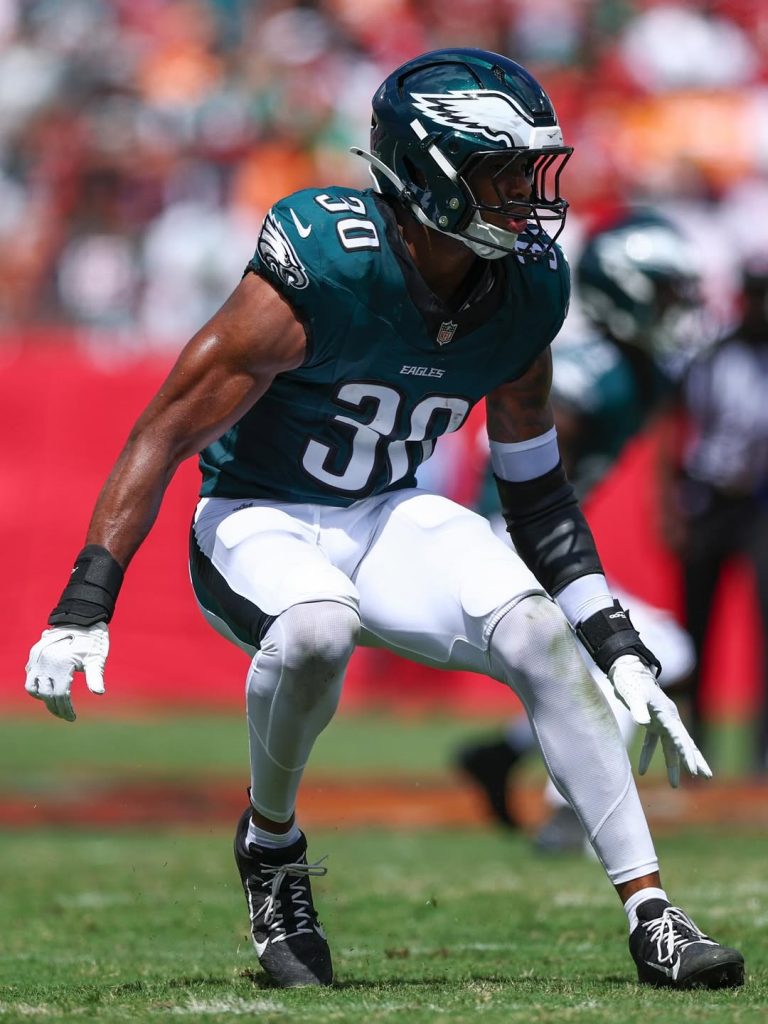
As the Eagles push toward the postseason, Jihaad Campbell waits — not frustrated, not diminishing, but sharpening himself for when the door reopens. And make no mistake: within the organization, the belief is unchanged. Campbell is not just part of Philadelphia’s future. He may be one of the players who defines it.